
An overnight shift may be quieter than a daytime shift, but it is never less important. In many ways, overnight care carries an even greater responsibility because our clients are placing their safety, comfort, and well-being in our hands during the hours when they are most vulnerable, while they sleep.
When a client and their family welcome an Evergreen caregiver into their home overnight, they are trusting us with something incredibly important. They are trusting us to be there if the client needs help, to recognize when something is not right, to help maintain a safe environment, and to provide reassurance that their loved one is not alone.
Being an overnight caregiver means being present, attentive, respectful, and prepared. Our responsibility does not sleep simply because our client does.
When No One Is Watching, Our Standards Still Matter
Overnight caregivers have a unique responsibility. Often, the client is asleep, and family members are not present to see the care being provided. They may never know about the safety checks you completed, the assistance you provided, or the small things you did throughout the night to make their loved one more comfortable.
That does not mean our level of care should ever change. In fact, it means we must remain even more vigilant.
Our clients and their families may not see every moment of care, but they trust that we are doing what we were hired to do. That trust is something we earn by consistently doing the right thing, even when no one is there to observe it or report it.
Professionalism is not about who is watching. It is about who we are as caregivers.
The true measure of a caregiver is not what we do when someone is watching. It is what we do when no one is.
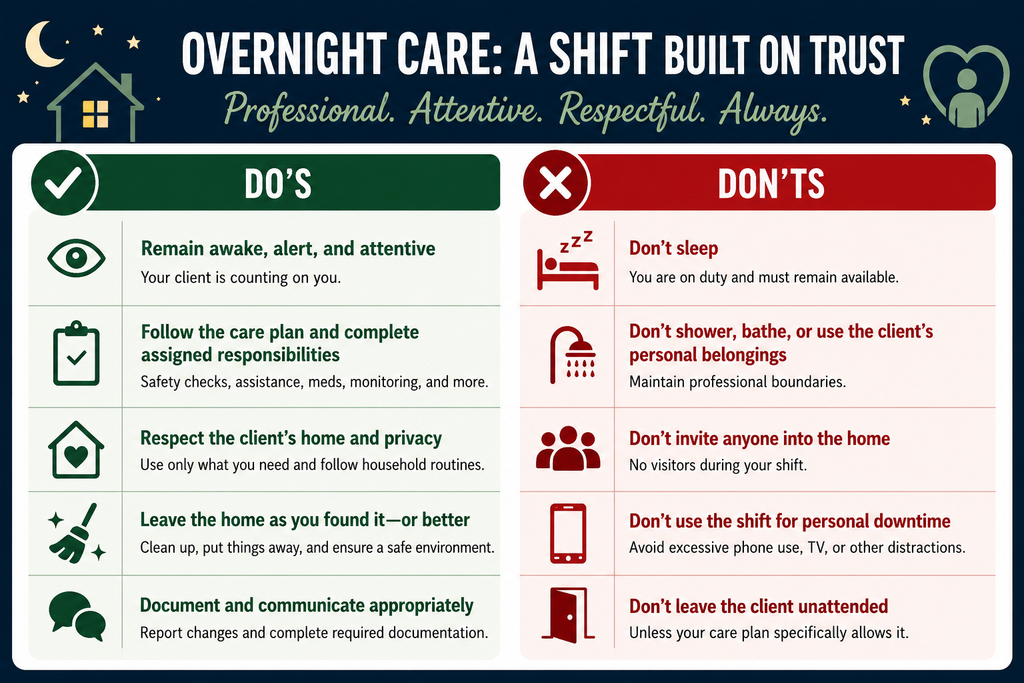
The Do’s of an Overnight Shift
DO remain awake, alert, and attentive.
Sleeping while on an overnight shift is never appropriate, and may subject to termination. Even when a client is sleeping peacefully, you are still on duty and responsible for being available and attentive.
Listen for movement. Be aware of changes in your client’s condition. Follow the care plan and any specific overnight instructions and tasks. If something doesn’t seem right, don’t ignore it, communicate with the appropriate person or supervisor.
DO complete your assigned responsibilities.
Overnight care can include many different responsibilities depending on the client’s needs and care plan. This may include safety checks, repositioning, toileting assistance, medication reminders, monitoring, companionship, light housekeeping, or other approved duties.
Quiet periods are an opportunity to remain attentive and complete appropriate responsibilities, not an opportunity to treat the shift as personal downtime.
DO maintain professional boundaries.
Remember that you are working in someone’s home. It is their personal space, their belongings, and their environment.
Use only the areas and items that are appropriate for your role. Respect the client’s routines, preferences, privacy, and property. Do not treat the home as though it were your own.
DO leave the home as you found it, or better.
This is one of the simplest ways we can demonstrate professionalism and respect.
Before ending your shift, take a moment to look around. Did you put away everything you used? Did you clean up after yourself? Are items back where they belong? Is the client’s environment safe, clean, and comfortable for the morning?
Our goal should be to leave the client’s home exactly as we found it, or, when appropriate, even better than we found it.
The family should walk into their home in the morning and see evidence of a caregiver who cared, not evidence that someone spent the night there.
DO document and communicate appropriately.
Accurate documentation and communication are essential parts of quality care. Record the information required by the agency and communicate important changes, concerns, or observations through the appropriate channels.
Never assume that because the night was quiet, there is nothing worth communicating.
The Don’ts of an Overnight Shift
DON’T sleep.
This deserves repeating because it is one of the most important responsibilities of an overnight caregiver.
A sleeping caregiver cannot reliably respond to a client’s needs, recognize a change in condition, hear a call for assistance, or respond to an emergency. Being awake and alert is fundamental to providing safe care.
DON’T shower, bathe, or use the client’s personal belongings for your own needs.
The client’s home is your workplace. Their bathroom, bedroom, food, personal items, and household resources are not there for your personal use.
Maintain professional boundaries and remember that you are a guest in someone’s home.
DON’T invite anyone into the client’s home.
Friends, family members, or other visitors should never be brought into a client’s home during your shift.
The client’s privacy, safety, and security must always come first.
DON’T spend the shift on your phone or other personal activities.
Checking your phone when appropriate may be necessary, but excessive texting, social media, streaming television, gaming, or other personal activities can become distractions.
If your attention is focused on your phone, it isn’t focused on your client.
DON’T assume that a quiet client means an uneventful shift.
A client who is sleeping may still need monitoring or assistance. Changes in breathing, mobility, comfort, behavior, or other conditions may not announce themselves loudly.
Stay observant. Follow the care plan. Know what is expected of you.
DON’T leave the client unattended unless your care plan specifically allows it.
If you are unsure about what is expected during an overnight shift, ask. Never make assumptions when a client’s safety is involved.
You Are a Guest in Someone’s Home
Home care is different from working in a hospital, facility, or office. We enter our clients’ homes, their personal spaces, and their lives.
That is a privilege.
When you walk through a client’s front door, remember that you are entering a place where someone lives, rests, keeps their memories, and feels most comfortable. Treat their home with the same respect you would want someone to show your own.
That means being mindful of noise. Respecting privacy. Handling belongings carefully. Cleaning up after yourself. Following household preferences. Maintaining boundaries.
And most importantly, it means remembering that the client is not simply receiving a service, they are trusting another person to care for them in their own home.
Overnight Care Is More Than “Being There”
A successful overnight shift may not have dramatic moments. Sometimes, the greatest success is that nothing went wrong.
- The client slept safely.
- Their needs were met.
- Their environment remained comfortable.
- Their family was able to rest knowing someone they trusted was there.
That IS meaningful care. As caregivers, we sometimes don’t get to see the immediate impact of what we do. A family member may not be there to thank us at 2:00 a.m. A client may not remember every safety check we completed. There may not be anyone there to see that we stayed awake, remained attentive, cleaned up after ourselves, or quietly made sure everything was ready for the morning.
Do it anyway.
- Do it because it is your responsibility.
- Do it because you are a professional.
- Do it because it is the right thing to do.
- And do it because someone has trusted you with the care of a person they love.
Before You Walk Out the Door
At the end of every overnight shift, take a moment before you leave and ask yourself:
- Did I remain awake, alert, and attentive?
- Did I follow the client’s care plan?
- Did I respond appropriately to my client’s needs?
- Did I maintain professional boundaries?
- Did I respect the client’s home and belongings?
- Did I clean up after myself?
- Is the client safe and comfortable for the morning?
- Did I document and communicate what was necessary?
- Would the client and their family feel that I treated their loved one and their home with the same care and respect I would want for my own family?
If the answer is yes, you have done more than complete a shift. You have honored the trust placed in you.
The Privilege of Overnight Care
Being an overnight caregiver is about more than filling a schedule. It is about being a steady, trusted presence during the hours when someone may be at their most vulnerable.
Your client is counting on you, even while they sleep.
Their family is counting on you, even when they are not there.
And Evergreen is counting on you to uphold the standard of care we promise every family we serve.
Thank you for treating every overnight shift as the responsibility—and the privilege—it truly is.
This could work especially well as a Caregiver Corner feature in the newsletter, with a sidebar titled “Overnight Shift Quick Check” featuring the 8–9 questions from the end. That would make the article easier for caregivers to scan while preserving the more meaningful message.